Digital Reflections - The Death of Corporate?
Open your feed this month and you'll find whiplash. One camp says the robots are coming for everything: The Economist has been telling readers to brace for an "AI jobs apocalypse," and this summer saw an extraordinary open letter - signed by tech leaders from OpenAI, Google, and Anthropic alongside more than a dozen Nobel-laureate economists - warning that AI could transform the economy "faster than the Industrial Revolution" and drive large-scale job displacement.
The other camp points to the data and shrugs. A new study from Ramp and Revelio Labs, tracking AI spending across more than 21,000 U.S. firms, found that companies investing heavily in AI grew headcount by over 10% in the two years after adoption - with entry-level hiring growing even faster. Low-intensity adopters saw no change at all (see this post here for a good critique of the study).
So which is it? Jobs apocalypse or hiring boom?
Honestly, I think that's the wrong question.
Every one of these stories is fighting over the same narrow frame: will this job, or that occupation, be automated away? It's an understandable question, and an almost unanswerable one, which is exactly why the studies keep contradicting each other. Task-level exposure scores, hiring surveys, and firm-level spend data all measure something real, but they're measuring different things, at different time horizons, in different corners of the economy.
The more interesting story isn't about individual jobs. It's about the corporation itself.
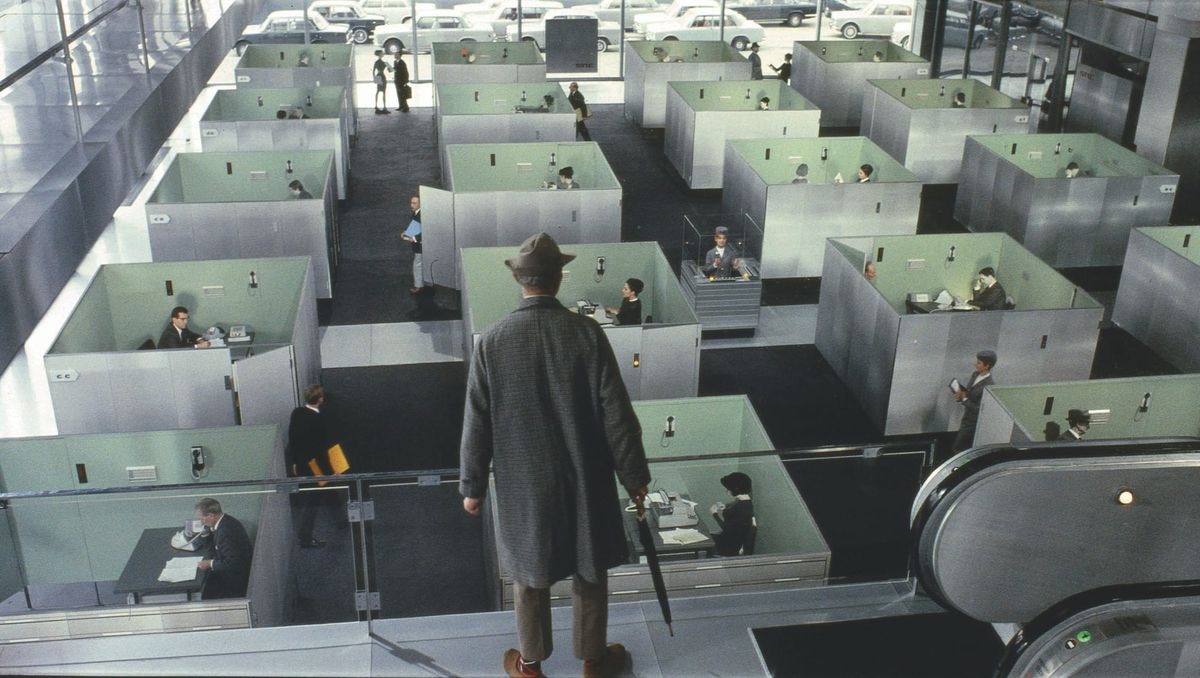
For a century, the modern corporation has been our best answer to a hard problem: how do you get thousands of people to pull in the same direction? The answer was scale - more people, more layers, more process - bought at a steadily rising price in coordination.
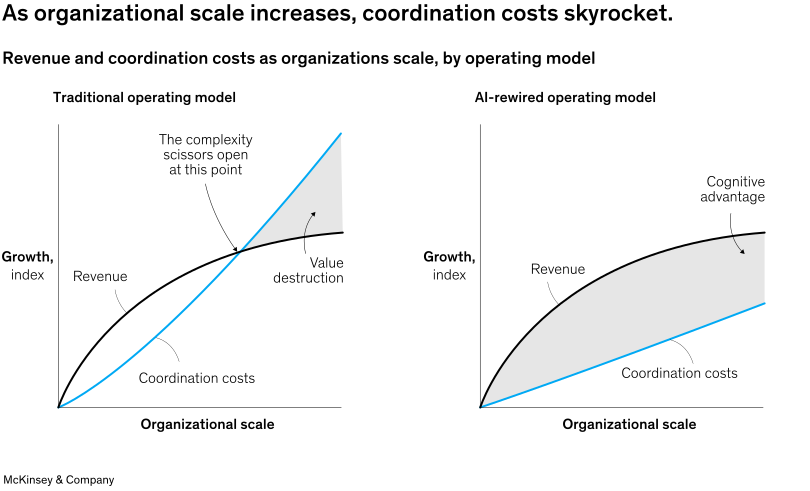
Anyone knows the pattern: the outfit that moved fast at $5 billion in revenue gets sluggish at $20 billion and grinds at $50 billion, as more approvals, more committees, and more middle-management layers get added just to keep everyone pointed the same way. McKinsey researchers describe this as a pair of scissors opening: revenue growth follows the familiar S-curve, but coordination costs just keep climbing, and the gap between the two blades is where organizational drag lives.
What makes this AI cycle different from prior waves of business process reengineering is that those efforts left the coordination layer itself untouched - same approval chains, same headcount, just faster typing. AI is the first technology aimed squarely at coordination itself: routing decisions, synthesizing information, and orchestrating work in ways that don't require another layer of managers to hold it all together. That's why we find the companies capturing real value aren't the ones bolting a chatbot onto an unchanged org chart - they're the ones redesigning how decisions get made in the first place.
That's the real pressure AI puts on the modern firm. Not "will my job survive," but "does my organization still need this much coordination overhead to achieve the scale we want?" You don't need to buy into the one-person-unicorn hype - most work still benefits from teams, specialization, and shared infrastructure - to see that every company now faces a version of this question. AI lets fewer people coordinate more, which means the traditional bargain of the corporation - more scale in exchange for more layers - is up for renegotiation.
The individual-job debate will keep generating contradictory headlines for years, because it's the wrong unit of analysis. The organizations that figure out how to capture AI's advantage won't be the ones that automate a task here or there. They'll be the ones willing to ask a much bigger question: now that coordination is cheaper, what should this company even look like?
Subscribe to this newsletter and follow me on social media for more publications and thoughts:
LinkedIn
Mastodon